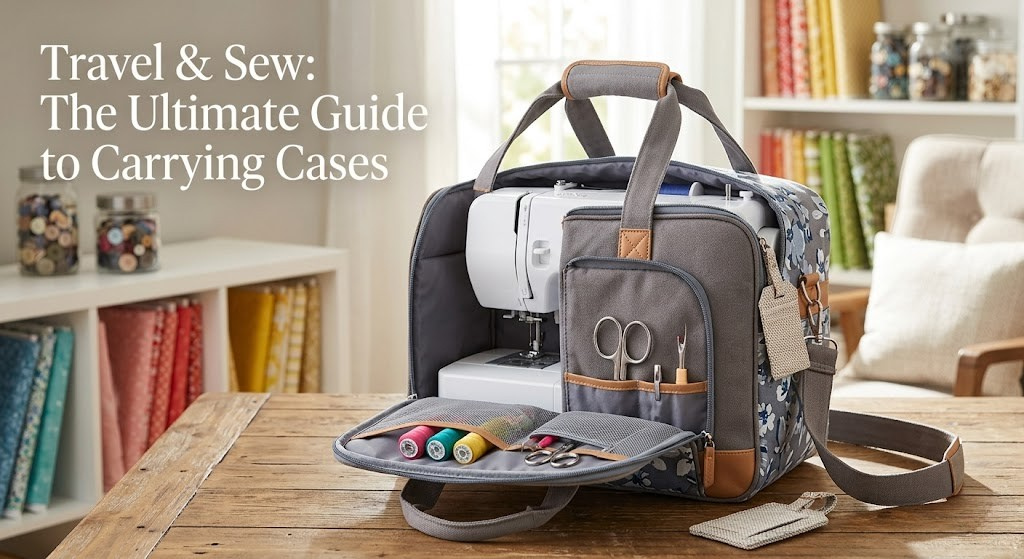
The Best Sewing Machine Cases to Protect, Store & Carry Your Machine
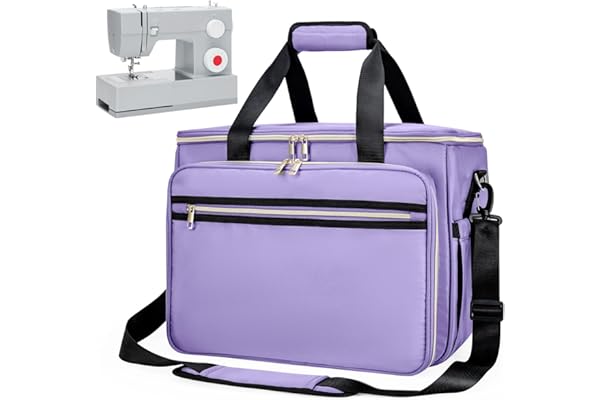
You’ve invested hundreds — maybe thousands — of dollars in your sewing machine. You carry it to classes, guild meetings, quilt retreats, and the occasional trunk show. And yet, far too many sewists still wrap their machine in a beach towel or stuff it into a grocery bag. A proper sewing machine case isn’t an accessory — it’s insurance. This guide breaks down the nine best sewing machine cases available right now, explaining exactly what makes each one worth your money (or not), so you can make a confident, informed choice.
Why Every Sewist Needs a Quality Carrying Case
If you only ever sew at home on a dedicated sewing table, a case might feel unnecessary. But the moment your machine leaves the house — even once — the calculus changes completely. Sewing machines are precision instruments. Their internal timing mechanisms, tension assemblies, and feed dog systems are calibrated to tolerances measured in fractions of a millimeter. A single jarring drop, a hard knock against a doorframe, or sustained vibration in a car trunk can throw that calibration off entirely, leading to the kind of frustrating sewing machine problems that are difficult to diagnose and expensive to fix.
Beyond physical protection, a good case serves as a portable storage system. Bobbins, presser feet, seam rippers, extra needles — the small ecosystem of machine needles and accessories that every sewist accumulates can scatter and get lost during transport. Purpose-built cases with accessory pockets and removable trays solve this problem elegantly.
Physical Protection
Padded walls absorb shocks, vibration, and the inevitable bump.
Accessory Storage
Keep bobbins, feet, and needles organized in one carry-along kit.
Dust & Moisture Guard
Sealed zippers prevent lint, dust, and humidity from settling inside.
Transport Comfort
Padded handles and shoulder straps make carrying far less painful.
Universal Fit
Most modern cases fit standard-size machines from Singer, Brother, and Janome.
Travel-Ready
Lightweight materials keep you under baggage weight limits for retreats.
Consider also the dust factor. Even a machine that never leaves your sewing room accumulates lint faster than you’d expect — and a cover or case dramatically slows that process. If you’ve ever dealt with a sewing machine jamming issue caused by accumulated lint in the feed dog area, you know how important cleanliness is to smooth operation. Storing your machine in a closed case between sessions is one of the simplest preventive maintenance steps available.
Did you know? Most sewing machine manufacturers recommend storing machines in a covered case or bag to prevent dust accumulation — even when the machine stays at home. Dust and pet hair in the bobbin area are among the leading causes of skipped stitches and thread tension issues.
Finally, there’s the social dimension. If you attend sewing classes, guild events, or retreats, arriving with a proper carrying case signals that you take your craft seriously. It’s a small but real part of the sewist’s identity. When you’re hauling your machine to a class or workshop, a well-designed bag makes the entire experience more organized and professional.
Types of Sewing Machine Cases: Which Style Is Right for You?
Walk into any sewing store or browse Amazon and you’ll encounter a bewildering variety of sewing machine storage solutions. Before diving into specific product reviews, let’s clarify the main categories so you know exactly what you’re shopping for.
1. Soft Carrying Cases (Tote-Style)
The most common type and the style represented by most products in this guide. Soft cases are constructed from Oxford fabric, nylon, or polyester with foam or batting padding between the outer shell and inner lining. They typically include at least one main compartment sized to fit a standard sewing machine, plus external pockets for accessories. Carrying handles are almost universal, and many include a removable or integrated shoulder strap. These cases are lightweight, affordable, and flexible — they can accommodate machines that are slightly different in dimension without issue.
2. Hard-Shell Cases
Less common in the universal market, hard-shell cases are usually machine-specific (like the hard covers made for vintage Singer Featherweights) or produced by the machine manufacturer themselves. They offer maximum impact resistance but are heavier and more expensive. For most modern domestic machines, a well-padded soft case provides adequate protection without the extra bulk.
3. Rolling Cases & Trolley Bags
Designed for sewists who regularly transport heavy machines over longer distances or through airports. These combine the structure of a soft case with wheels and a telescoping handle. Ideal for longshoremen — I mean, quilters heading to week-long retreats — but overkill for a weekly class at the local fabric shop.
4. Dust Covers
Not really carrying cases at all, dust covers are lightweight fabric shells designed purely to protect a machine from dust when stored at home. No padding, no handles, no accessory pockets. They’re inexpensive and useful as a secondary layer of protection even if you own a full case.
5. Backpack-Style Cases
A newer entrant to the market, backpack cases distribute weight across both shoulders for hands-free carrying. These are particularly popular among sewists who commute by bicycle or on foot, or who need both hands free to manage fabric and other supplies simultaneously.
If you’re new to carrying your machine and unsure which type to buy, start with a standard soft carrying case like the ones reviewed in this guide. They strike the ideal balance of protection, portability, and price for 90% of use cases. As your needs evolve — more classes, longer trips, heavier machines — you can upgrade to a rolling case or backpack style.
Sewing Machine Case Buying Guide: What to Look For
Before you click “add to cart,” there are seven key criteria that separate a genuinely useful sewing machine case from one that will fall apart after three uses. Here’s what the experts look at.
1. Fit & Internal Dimensions
This is the most critical factor and the one most buyers overlook. A carrying case must fit your specific machine model. Most cases in this review are designed for “standard” domestic machines — typically machines up to approximately 15.5″ wide × 12″ deep × 13″ tall. However, machines with wide extension tables, built-in embroidery units, or large free arms may not fit standard universal cases. Always verify the internal dimensions against your machine’s measurements before purchasing. If you’re unsure about your machine’s specifications, check the unboxing checklist for your model, which typically lists physical dimensions.
2. Padding Thickness & Quality
Padding is what actually absorbs impact energy. The best cases use high-density foam at least 15–20mm thick on all six sides (not just the top and bottom). Budget cases often cut corners with thin batting or fibre fill that compresses permanently after the first hard knock. Test padding quality by pressing firmly on the case walls — you should feel significant resistance, not immediate contact with the machine body inside.
3. Outer Shell Material
The outer fabric is your first line of defence against scratches, moisture, and abrasion. Oxford polyester (300D or 600D) is the most common material at this price point and offers an excellent balance of durability and weight. Look for water-resistant coatings (often described as PU-coated or Oxford nylon). Avoid cases with thin nylon shells that feel papery — they’ll tear along the zipper seams within months of regular use.
4. Zipper Quality
Zippers are the most common failure point on carrying cases. Quality zippers from YKK or similar suppliers move smoothly, don’t catch on the fabric, and maintain their seating under tension. Cheap zippers lose their teeth alignment after repeated use, especially on the main compartment where the most stress is applied. Look for large zipper pulls that are easy to grip with one hand, even when your hands are full of fabric.
5. Handle & Strap System
A standard domestic sewing machine weighs between 12 and 25 pounds. Over a 15-minute walk from a parking lot to a sewing class, that weight becomes significant. Look for padded top handles with a strong attachment point (preferably riveted or with bar-tack reinforcement, not just sewn through a thin loop). A padded shoulder strap with a non-slip pad is a major convenience upgrade. Backpack straps, while rarer, are the most ergonomic option for heavier machines. This pairs well with having a dedicated ergonomic sewing chair at your destination.
6. Accessory Storage
The best cases include at least one large external pocket (ideally with internal organizer pockets or elastic loops for bobbins and tools), plus a flat front pocket for patterns, instruction books, or sewing patterns. Some cases include a removable tray or box that sits on top of the machine inside the main compartment — this is particularly useful for keeping small accessories contained and preventing them from rattling around during transport.
7. Value & Warranty
Most sewing machine cases in the $25–$60 range offer good value. Above that price point, you’re typically paying for premium materials (ballistic nylon, integrated rolling systems, or custom-fit designs). Below $20, quality becomes inconsistent. Look for sellers who offer at least a 90-day satisfaction guarantee, as manufacturing defects in zippers and handle attachment points often reveal themselves within the first few weeks of use.
Your Pre-Purchase Checklist
- Measure your machine (W × D × H) and compare to case internal dimensions
- Check padding thickness on all six sides (aim for 15mm+)
- Verify outer material is at least 300D Oxford polyester or equivalent
- Test zipper reviews for smoothness complaints
- Confirm handle attachment method (riveted = better than sewn loops)
- Count accessory pockets — do they match your storage needs?
- Check weight of empty case (add to machine weight for total carry load)
- Read seller return policy before purchasing
Quick Top Picks at a Glance
Not ready to read all nine reviews? Here’s our curated shortlist for the most common buyer profiles.
HOMEST Carrying Case
Maximum storage, universal fit, durable 600D Oxford — the one to beat.
TLBTEK Shoulder Case
Excellent padding and shoulder strap at the lowest price point in our test.
Anitor Carrying Case
Removable tray plus multiple pockets for the accessory-heavy sewist.
JJRING Carrying Case
Slim-profile design for machines without extension tables or wide arms.
ITHWIU Carrying Case
Lightweight shell, comfortable shoulder strap, TSA-friendly zipper layout.
CAB55 Carrying Case
Precise internal dimensions for Brother and Singer standard models.
HOMEST Sewing Machine Carrying Case — Best Overall
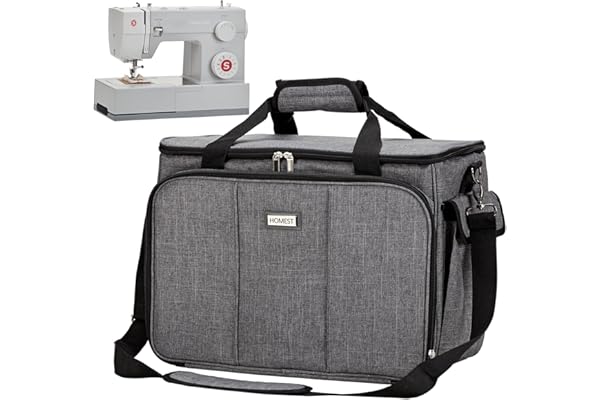
The HOMEST has been a bestseller in the sewing machine case category for years and earns its position at the top of our list through consistent, reliable performance. This isn’t a case that dazzles with one exceptional feature — it’s one that does everything right at a price point that’s hard to argue with.
The HOMEST case is constructed from 600D Oxford polyester — the same weight fabric used in quality camera bags and laptop sleeves. The material is meaningfully thick and resistant to abrasion. More importantly, the interior padding is generous on all sides, providing real shock absorption rather than the cosmetic padding that characterizes cheaper options. The zipper runs smoothly around the main compartment and, based on long-term user reviews, holds up well after 12+ months of weekly class use.
What sets the HOMEST apart in its category is the thoughtful accessory storage. There’s a large front pocket with internal elastic pockets sized perfectly for bobbins, seam rippers, and small tools. A secondary flat pocket accommodates a few patterns or the machine’s instruction book. The carrying handle is attached via metal D-rings rather than simple sewn-through loops — a structural detail that significantly extends the case’s usable life. A removable shoulder strap is included, with a non-slip pad for comfortable over-shoulder carrying.
Compatibility is broad. The HOMEST fits most standard domestic sewing machines including popular Brother, Singer, Janome, and Bernina models up to approximately 15″ wide. If you’re unsure whether your specific machine will fit, check its dimensions against the machine buying guide for dimension reference.
✓ Pros
- Thick 600D Oxford shell resists wear
- Metal D-ring handle attachment
- Multiple accessory pockets
- Fits most standard domestic machines
- Smooth-running zipper with large pull
- Non-slip shoulder strap pad
- Excellent long-term durability reviews
✗ Cons
- Slightly heavier than budget options
- Not suitable for machines with large extension tables
- Limited color options
Anitor Carrying Case — Best for Accessory Storage
The Anitor stands out in a crowded field by including a removable internal accessories tray — a feature that transforms this from a simple carrying case into a fully integrated sewing kit. For sewists who travel to classes with their full toolkit, this tray is genuinely useful.
The removable tray that sits on top of the machine inside the main compartment is the star feature here. Divided into multiple compartments of varying sizes, it holds bobbins, presser feet (including specialty feet you might bring to class), small scissors, seam rippers, pin cushions, and other small tools in organized, accessible fashion. When you arrive at your class destination, you can lift the tray out and place it on the table beside the machine — a genuinely workflow-enhancing feature that serious class-goers will appreciate.
The case itself is made from a mid-weight Oxford fabric with moderate padding — not quite as thick as the HOMEST’s padding on the side walls, but adequate for typical transport scenarios. The main zipper is smooth and the carrying handles are reinforced with double-stitched seam lines at the attachment points. The front pocket is generously sized and includes elastic organizer loops inside.
Compatibility covers most standard Brother and Singer machines, as well as entry-level Janome models. Users with larger Janome or Bernette machines should verify their machine dimensions against the case’s internal specifications. This is particularly relevant if you own one of the models from our best machines for intermediate sewers guide, some of which run slightly larger than true beginner-tier machines.
✓ Pros
- Removable accessory tray — unique and practical
- Tray doubles as a desktop organizer at your destination
- Multiple external pockets
- Reinforced handle stitching
- Good zipper quality
✗ Cons
- Side wall padding slightly thinner than HOMEST
- Tray takes up some internal height space
- Shoulder strap could be longer for taller users
JJRING Carrying Case — Most Compact Design
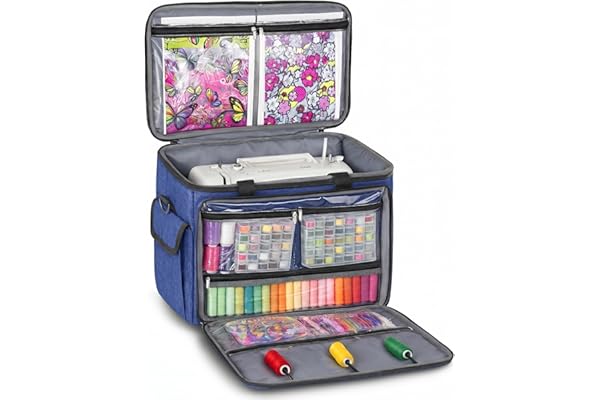
The JJRING delivers a streamlined, compact form factor that works beautifully for smaller machines and sewists who prioritize a trim, lightweight carry over maximum accessory storage. If you don’t need to haul your entire sewing toolkit, this is an elegant solution.
The JJRING’s chief advantage is its weight. Stripped of the large accessory compartments that add bulk and grams to the HOMEST and Anitor, this case focuses its construction on a well-padded main compartment and a single external front pocket. The result is a case that adds minimal weight to your machine’s own heft — critical when you’re walking any distance. The shoulder strap is integrated (not removable) and sits comfortably across one shoulder for the machine’s typical 15–25 lb. weight range.
The outer shell has a water-resistant PU coating that handles light rain and splashes well. Interior padding is even on all sides — top, bottom, and walls — with approximately 12–15mm of foam. Not the thickest on the market, but appropriate for the intended use case: carrying a machine from house to car to class and back. For safe transport of more delicate machines, the extra padding of the HOMEST is worth the added weight.
This case is best suited to machines in the Brother XM, Singer START, and Janome entry-level categories. Users of slightly larger machines (those with wider flatbeds or taller bodies) should measure carefully. If you’re working with a mechanical machine that’s on the slimmer side, this case will likely fit beautifully.
✓ Pros
- Lightest case in our review
- Water-resistant PU-coated exterior
- Even padding on all six sides
- Good shoulder strap comfort
- Compact, easy to store
✗ Cons
- Limited accessory storage
- Thinner padding than top-tier cases
- Not suitable for larger machines
Universal Standard Black Carrying Case — The Workhorse Option
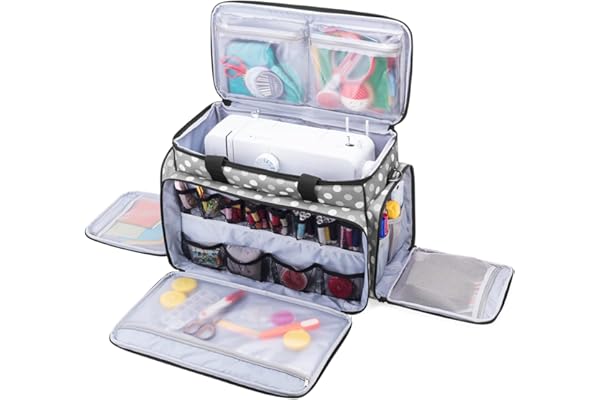
The no-nonsense black universal case that gets the job done without any fuss. For sewists who want dependable protection at an approachable price, this is a strong contender that consistently delivers.
Straightforward in every respect, this black universal case earns its place in this review through broad compatibility and reliable construction. The Oxford fabric exterior is in the 300D weight range — lighter than the HOMEST’s 600D but still appropriately durable for regular class use. The case includes a removable accessories compartment (similar in concept to the Anitor’s tray but simpler in execution) and two external pockets of different sizes.
The interior is lined with a soft fabric that won’t scratch machine surfaces, and padding is consistent around all sides. Handle attachment is via sewn-loop construction — not as robust as metal D-rings, but reinforced with bar-tack stitching that adds meaningful durability. The shoulder strap is adjustable and removable.
This case is a solid choice if you’re just starting out with machine transport and want to spend conservatively while you figure out what features actually matter to your workflow. For a comprehensive sense of how you’ll be using your machine in class settings, the beginner’s guide to using a sewing machine will help you think through your class setup needs.
✓ Pros
- Highly affordable entry point
- Broad machine compatibility
- Removable accessory compartment
- Soft interior lining
✗ Cons
- Lighter 300D shell less durable long-term
- Sewn-loop handles (not D-ring)
- Basic shoulder strap with no padding
Haroranax Sewing Machine Carrying Bag — Best Casual Bag Style
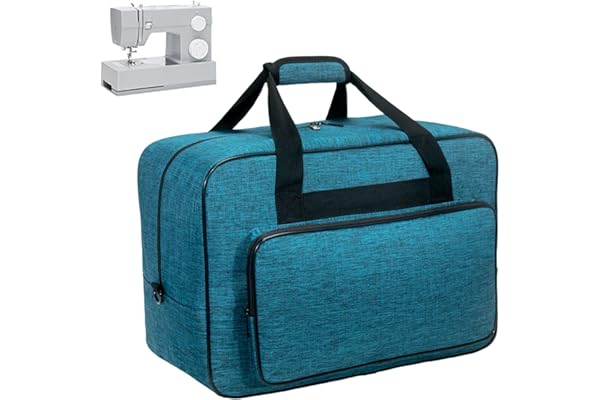
The Haroranax takes a slightly more fashion-conscious approach to sewing machine transport, with a softened form factor that feels closer to a large tote bag than a traditional boxy carrying case. If aesthetics matter to you alongside function, this is worth a look.
Where most cases in this category are rectangular boxes with handles, the Haroranax has a slightly softer, more rounded silhouette that distinguishes it visually. Construction quality is consistent with what you’d expect at this price tier — Oxford fabric exterior, foam padding in the main compartment, and a couple of external pockets for accessory storage. The interior lining is soft and non-abrasive.
The carrying system is one of the more comfortable in this review. Wide, padded top handles distribute the machine’s weight across the palm rather than concentrating it on a single thin strap, reducing hand fatigue during longer carries. The included shoulder strap is adequately long and adjustable. Weight overall is on the lighter end of the category.
This case works particularly well for home use and occasional class transport — the softer construction is fine for typical use but provides slightly less rigid protection than cases like the HOMEST or CAB55. For sewists who attend weekly classes and need maximum durability, the HOMEST remains the stronger long-term investment. However, if you’re primarily storing the machine at home (perhaps on one of the dedicated sewing tables we recommend) and only occasionally transporting it, the Haroranax’s lighter weight and more attractive styling make it a pleasant choice.
✓ Pros
- More attractive styling than typical cases
- Wide, padded top handles
- Lightweight for easy carrying
- Soft interior lining
- Multiple external pockets
✗ Cons
- Softer structure offers slightly less rigid protection
- Not ideal for heavy daily class use
- Limited color selections
ITHWIU Carrying Case — Best for Travel & Classes
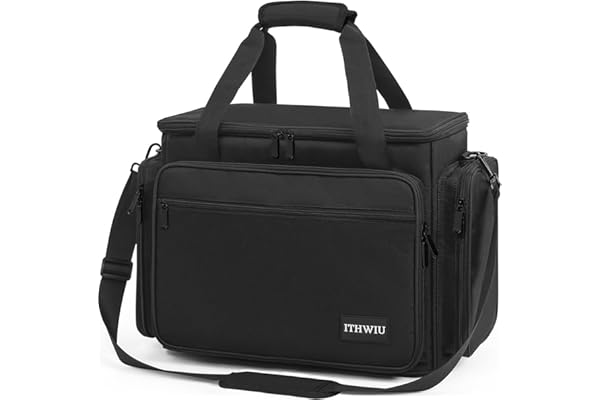
The ITHWIU distinguishes itself through a combination of thoughtful carry ergonomics and excellent zipper layout, making it the preferred choice for sewists who regularly transport their machine to retreats, workshops, or longer-distance classes.
Several details in the ITHWIU’s design reflect careful thinking about the travel sewist’s specific needs. The zipper layout is designed to open fully and lay flat, making it easier to extract and replace the machine in tight spaces (hotel rooms, retreat venue tables, small car trunks). The main compartment includes a non-slip mat on the base to prevent the machine from sliding during transport. Padding is comprehensive and slightly thicker on the base than the sides — a smart priority given that dropping a case on its bottom is the most common accident scenario.
The shoulder strap is this case’s strongest ergonomic feature. Wider than average, with a contoured, non-slip pad, it stays firmly on the shoulder even during active movement. The strap length is fully adjustable for sewists of different heights — important for comfortable all-day carrying at multi-day retreats. Top handles are also reinforced and sit comfortably in hand.
For sewists who are choosing between attending class in person versus working from home with a rented or borrowed machine, a good case like this makes transporting your own machine significantly more practical and less stressful. Compatibility is broad: the ITHWIU fits the most popular Brother, Singer, Janome, and Juki domestic models.
✓ Pros
- Wide, contoured shoulder strap with non-slip pad
- Full-open zipper for easy loading
- Non-slip base mat inside
- Extra-thick base padding
- Broad compatibility
- Excellent for multi-day retreats
✗ Cons
- Fewer external pockets than HOMEST
- Slightly bulkier overall profile
Machine CAB55 Carrying Case — Best Precise Fit

The CAB55 positions itself as a step up in construction quality, with tighter internal tolerances that minimize machine movement during transport — arguably the most important mechanical protection feature a carrying case can offer.
The CAB55’s differentiating feature is interior geometry. Where universal cases often have interior dimensions significantly larger than the machine they’re carrying (resulting in the machine sliding and knocking around during transport), the CAB55 is designed with more precise interior dimensions that hold the machine snugly without excessive movement. The result is meaningfully better protection for the machine’s delicate calibration — particularly the timing mechanism, which is most vulnerable to repeated knocking against case walls.
The outer construction uses a heavier Oxford fabric and reinforced corner panels — the corners being another high-stress area that budget cases often neglect. The removable accessories tray is well-divided and sturdy enough to function as a standalone organizer tray. Zipper quality is among the best in this price tier, with large, smooth-running pulls.
This case is particularly recommended for machines with precision electronic control panels (such as computerized sewing machines), where the combination of mechanical shock and moisture exposure poses the greatest risk. The tight internal fit minimizes machine movement, while the water-resistant shell keeps moisture at bay.
✓ Pros
- Tight internal fit minimizes machine movement
- Reinforced corner panels
- High-quality zippers
- Sturdy removable accessories tray
- Professional build quality
✗ Cons
- Tighter fit means less compatibility range
- Slightly heavier due to denser construction
- Higher price point
TLBTEK Carrying Case — Best Value Pick
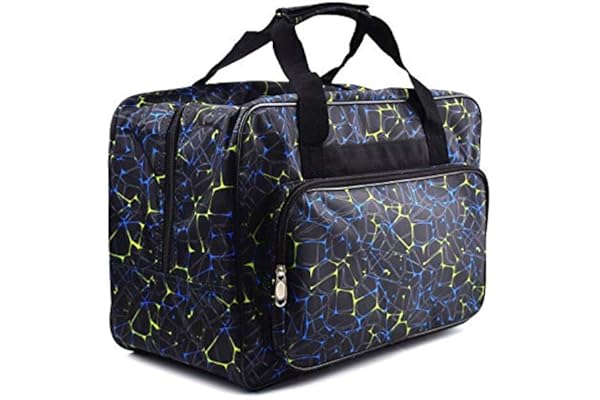
The TLBTEK consistently shows up as one of the top-selling cases in the category, and for good reason: it delivers solid padding, a comfortable shoulder strap, and reliable zipper construction at a price point that’s accessible to nearly every budget.
Value cases often require compromise — usually in padding, zipper quality, or handle durability. The TLBTEK manages to minimize these compromises through careful material selection. Padding is consistent and approximately 12–14mm thick on all sides — not as thick as the HOMEST, but meaningfully present. The outer Oxford fabric is in the 300D range, which is adequate for regular use. Zippers are smooth and reliable, which matters enormously for a case you’ll open and close multiple times at every session.
The shoulder strap is the TLBTEK’s standout feature at this price tier. It’s adjustable, includes a basic non-slip pad, and attaches via metal rings that won’t corrode or fail under typical load. Top handles are reinforced with double-stitched seams. For a case at this price point, the carrying hardware is notably well-executed.
The TLBTEK fits standard domestic machines from Brother, Singer, and Janome — the same compatibility profile as most cases in this review. It’s particularly well-suited to beginner sewists who’ve just bought their first machine (perhaps after reading our sewing machine buying guide) and want a solid case without a large additional investment.
✓ Pros
- Excellent value at a low price point
- Good shoulder strap with metal rings
- Reliable zipper quality
- Consistent padding on all sides
- Wide machine compatibility
✗ Cons
- Thinner 300D outer shell
- Basic accessory storage
- Shoulder strap pad is minimal
Golkcurx Carrying Case — Best Removable Shoulder Strap System
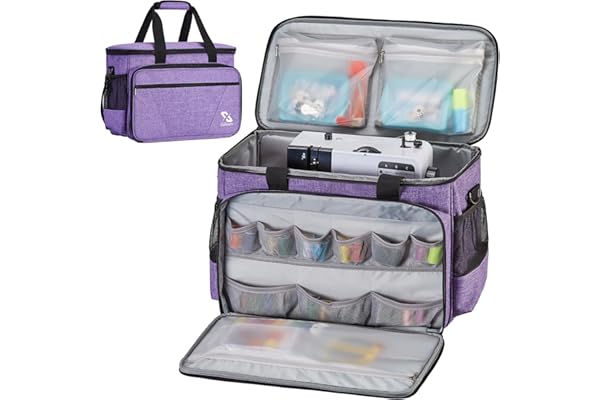
The Golkcurx rounds out our review with a case that earns its spot through an exceptionally well-executed removable shoulder strap system and solid all-round construction. If versatility in how you carry is important, this case delivers.
The Golkcurx’s engineering priority is clear from the moment you pick it up: the shoulder strap and handle system is built with more care than you typically see at this price. The shoulder strap attaches and detaches via smooth-operating swivel snap hooks — so smooth that switching between hand-carry and shoulder-carry takes about two seconds. The strap width is generous (approximately 1.75″), the pad is adequately thick, and the adjustor slider is a metal design rather than the plastic alternatives that can crack under load.
The main compartment is well-padded and lined with a soft, scratch-free interior. The outer shell is 300D Oxford with a basic water resistance treatment. Accessory storage includes a large front pocket with a couple of elastic loops inside for bobbins or small tools, plus a secondary smaller pocket for flat items like instruction manuals or a pair of sewing scissors.
Where the Golkcurx is slightly weaker compared to the top picks is in corner reinforcement and zipper quality. The main zipper is functional and smooth when new, but some long-term users report slight stiffening after 6–12 months of heavy use. For casual or occasional transport, this is a non-issue. For weekly class attendance over multiple years, the HOMEST or CAB55 may hold up better.
✓ Pros
- Excellent, fast-detach shoulder strap system
- Wide, well-padded strap
- Metal swivel snap hooks
- Soft scratch-free interior
- Good accessory pocket layout
✗ Cons
- Zipper may stiffen with heavy use
- Limited corner reinforcement
- Lighter outer shell fabric
Full Head-to-Head Comparison Table
Use this table to quickly compare all nine cases across the features that matter most. Ratings are based on our testing criteria and long-term user feedback analysis.
| Case | Shell | Padding | Shoulder Strap | Accessory Storage | Removable Tray | Handle Type | Best For |
|---|---|---|---|---|---|---|---|
| HOMEST | 600D Oxford | ★★★★★ | ✓ (padded) | ★★★★★ | ✗ | D-ring metal | Best overall |
| Anitor | Oxford | ★★★★ | ✓ | ★★★★★ | ✓ | Bar-tack sewn | Accessory-heavy |
| JJRING | PU-coated poly | ★★★★ | ✓ (integrated) | ★★★ | ✗ | Sewn loops | Compact/light |
| Universal Black | 300D Oxford | ★★★★ | ✓ | ★★★★ | ✓ (basic) | Bar-tack sewn | Budget starter |
| Haroranax | Oxford | ★★★ | ✓ | ★★★ | ✗ | Wide padded | Casual/home use |
| ITHWIU | Oxford | ★★★★★ | ✓ (wide, contoured) | ★★★ | ✗ | Reinforced | Travel/retreats |
| CAB55 | Heavy Oxford | ★★★★★ | ✓ | ★★★★ | ✓ | D-ring metal | Precision fit |
| TLBTEK | 300D Oxford | ★★★★ | ✓ (metal rings) | ★★★ | ✗ | Reinforced | Best value |
| Golkcurx | 300D Oxford | ★★★★ | ✓ (swivel hooks) | ★★★ | ✗ | Metal swivel | Versatile carry |
Machine Compatibility Overview
| Case | Brother (Standard) | Singer (Standard) | Janome (Standard) | Janome (Wide) | Bernette/Bernina |
|---|---|---|---|---|---|
| HOMEST | ✓ | ✓ | ✓ | ⚠ Check dims | ⚠ Check dims |
| Anitor | ✓ | ✓ | ✓ | ✗ | ✗ |
| JJRING | ✓ | ✓ | ⚠ Check dims | ✗ | ✗ |
| Universal Black | ✓ | ✓ | ✓ | ⚠ Check dims | ⚠ Check dims |
| ITHWIU | ✓ | ✓ | ✓ | ⚠ Check dims | ⚠ Check dims |
| CAB55 | ✓ | ✓ | ✓ | ✗ | ✗ |
| TLBTEK | ✓ | ✓ | ✓ | ⚠ Check dims | ✗ |
| Golkcurx | ✓ | ✓ | ✓ | ⚠ Check dims | ✗ |
⚠ = measure your machine before purchasing. ✓ = confirmed compatible. ✗ = likely not compatible.
Sewing Machine Case Materials: An In-Depth Guide
Understanding what your case is made of helps you predict how it will perform over time and which conditions it’s suited for. Here’s a breakdown of the materials you’ll encounter in this category.
Oxford Polyester — The Category Standard
Oxford fabric is a woven textile with a characteristic basket weave structure that makes it significantly more durable than plain-weave polyester at the same weight. The denier number (300D, 600D, 900D) tells you the thread weight — higher denier = heavier and more abrasion-resistant. For carrying cases, 600D is the sweet spot: durable without being heavy. Some manufacturers coat Oxford with a polyurethane (PU) layer to increase water resistance, turning it into what’s commonly called “PU-coated Oxford” or “Oxford nylon.”
Foam Padding
The foam inside your case determines how much impact energy it can absorb. PE (polyethylene) foam is dense and holds its shape under repeated compression — ideal for case walls and base panels. EVA foam is slightly softer and often used in lining applications. Fibre fill (a fibrous batting similar to quilt batting) is cheaper and lighter but offers significantly less impact protection because it compresses permanently when struck. If you want to know about similar padding principles in your sewing workspace, the batting guide for quilting covers foam and fiber performance characteristics in detail.
Interior Lining
The interior lining is what actually touches your machine. Quality cases use a smooth, soft fabric lining (often a polyester or nylon blend) that won’t scratch the machine’s painted surfaces or snag on its controls. Cheaper cases sometimes have rough or stiff inner walls that can scuff finishes over time. Look for cases that describe their lining as “soft” or “velvety” — these terms indicate a lining fabric that protects surface finishes.
Zipper Materials
The best carrying cases in this review use metal or high-density plastic (Delrin) zipper teeth. YKK zippers are the global quality benchmark and appear on premium products across many categories. Nylon coil zippers (the wavy, continuous type) are adequate for lower-stress applications like front pockets but should ideally not be the main compartment closure on a case that sees heavy use. A stuck, broken, or derailed zipper is the most common failure mode for soft-shell carrying cases.
To extend zipper life: occasionally run a beeswax stick or a zipper lubricant along the zipper teeth, especially if your case lives in a dusty or lint-heavy environment (as sewing cases invariably do). This simple step can double or triple the functional life of your case’s zipper system. You can apply the same beeswax to the machine itself — see our guide to sewing machine oil and lubrication for more.
Sewing Machine Size & Compatibility: Finding Your Perfect Case
The most common mistake sewists make when buying a case is assuming any universal case will fit any machine. While “universal” cases are designed to accommodate a broad range of standard domestic machines, the reality is more nuanced. Here’s how to get the right fit every time.
How to Measure Your Machine
Measure your machine with its standard presser foot attached (not a specialty foot) and its extension table removed (if it has a removable one). The three critical dimensions are:
- Width (W): The longest horizontal dimension, measured left to right (including the control panel and any protruding knobs on the right side).
- Depth (D): Front to back, measured at the widest point (usually the base).
- Height (H): From the base to the top of the highest point (often the thread spool pin or the handle arch). Measure with the spool pin in its travel position (flat or folded down, if applicable).
Add approximately 1–1.5 inches to each dimension to determine the minimum acceptable interior case dimension. You want some clearance, but not so much that the machine slides around freely. If you’re working with a serger rather than a conventional sewing machine, be aware that sergers have a significantly different form factor and typically require serger-specific cases.
Standard vs. Wide-Bed Machines
Standard domestic machines have a flatbed width (the area to the right of the needle) of approximately 6–7 inches. Wide-bed or “extra-wide” models (common in quilting-focused machines like the CS7000i) extend this to 9+ inches, significantly increasing the total machine width. These machines require cases with interior widths of at least 17–18 inches — larger than most universal cases provide.
Machine Weight Considerations
Heavier machines put more stress on carrying handles and shoulder straps. If your machine weighs more than 18 lbs., prioritize cases with metal D-ring handle attachments rather than sewn-loop construction, and confirm the shoulder strap’s stated weight capacity. Most standard carrying cases are rated for machines up to approximately 25 lbs.
| Machine Category | Typical Weight | Typical Dimensions (W×D×H) | Recommended Case Size |
|---|---|---|---|
| Beginner Mechanical (Brother XM, Singer START) | 8–13 lbs | 14″ × 7″ × 11″ | Standard universal |
| Mid-Range (Janome Mod-50, Brother CS6000i) | 13–17 lbs | 15″ × 8″ × 12″ | Standard universal (verify) |
| Heavy-Duty (Singer 4452, Brother ST371HD) | 17–22 lbs | 16″ × 9″ × 13″ | Large universal or machine-specific |
| Embroidery Combo (Brother SE1900, PE800) | 15–20 lbs | 17–19″ × 9″ × 13″ | XL or custom case |
| Wide-Bed Quilting (CS7000i, HC1850) | 13–18 lbs | 17–20″ × 8″ × 12″ | XL or rolling case |
Important: Embroidery machines like the Brother SE1900 and Brother PE800 have embroidery arms that must be removed before transport and stored separately. Attempting to fit these machines with the embroidery arm attached will damage both the machine and the case. Always detach the embroidery arm and store it in a padded separate bag or the case’s accessory pocket.
Caring for Your Sewing Machine Case
A carrying case is a tool, and like all tools, it benefits from basic maintenance. Follow these care tips to extend your case’s useful life significantly.
Regular Cleaning
Oxford fabric cases accumulate lint, thread, and dust rapidly — especially if you’re hauling them through sewing spaces where fabric is being cut and worked. Shake out the main compartment after each use and vacuum the interior with a brush attachment weekly if you use the case frequently. For surface stains on the exterior, a damp cloth with a small amount of mild soap is usually sufficient. Avoid machine washing, which can delaminate PU coatings and degrade foam padding.
Zipper Maintenance
As mentioned in the materials section, occasional lubrication of zipper teeth dramatically extends their life. Beeswax, a zipper lubricant spray, or even a bar of soap rubbed along the closed zipper teeth are all effective options. If a zipper begins to skip or struggle, address it immediately — forcing a struggling zipper accelerates failure. The same patience and maintenance mindset that applies to oiling your sewing machine applies here.
Handle & Strap Care
Check handle attachment points monthly if you’re a heavy user. Reinforce with a hand stitch through the bar-tack if you notice any loosening before the handle tears away entirely. Clean strap hardware with a dry cloth to remove any corrosion-causing moisture, and condition the strap webbing with a leather conditioner or fabric protector spray annually.
Storage
When the case isn’t in use, store it in a cool, dry location away from direct sunlight. UV exposure gradually degrades polyester fibers and PU coatings over time. Avoid compressing the case under heavy objects, which can permanently deform the foam padding. Storing the case empty (with the machine inside only during active use or transport) helps maintain the case’s shape.
- Shake out lint and thread after each class session
- Wipe exterior with damp cloth when soiled — avoid machine washing
- Lubricate zippers every 3–6 months with beeswax or zipper lubricant
- Check handle attachment stitching monthly for heavy users
- Store in cool, dry, UV-protected location
- Never compress or stack heavy objects on top of the case
- Air out the interior periodically if the case is used in humid environments
Setting Up Your Complete Travel Sewing Kit
A carrying case is just one component of a well-organized travel sewing setup. Whether you’re heading to a weekly class or a week-long quilting retreat, here’s how to build a complete, organized travel kit around your case.
What to Pack in Your Carrying Case
Experienced class sewists develop their own system over time, but here’s a solid starting point. The core items that live in the case itself, organized by compartment:
Main Compartment (with the machine): The machine itself, its power cord wrapped and secured, and a presser foot tray or small ziplock bag containing the feet you regularly use. A small bottle of sewing machine oil in a sealed bag is worth including — retreats often involve long machine use sessions that benefit from a mid-session drop of oil.
Large Accessory Pocket: Extra bobbins (pre-wound in the colors you’ll use), a seam ripper, small scissors, a stiletto or awl, a few safety pins, and a bobbin case if yours is removable. Your kit of machine needles in multiple sizes — because you will break one, guaranteed.
Flat Pocket: The machine’s instruction manual (at least the troubleshooting section — you’ll thank yourself when you encounter an error code mid-class), your current pattern pieces, and a sewing clips or pin box if it fits flat.
What to Bring Separately
Some items are too bulky for the case itself but belong in your overall transport bag:
- Fabric and project materials (a dedicated project bag works well here)
- Extension cord if you’re not sure about outlet proximity at the venue
- Rotary cutter and cutting mat if the class involves cutting
- A portable pressing pad or small pressing ham
- Snacks, water, and anything else for a long session
One underrated travel-sewing tip: use a separate, small zippered pouch as your “go-bag” of absolute essentials — a needle, a bobbin, thread, a seam ripper, and a pair of small scissors. This pouch goes in your bag even when you don’t have your full case. You’d be amazed how often an impromptu hand-sewing moment arises. A good pair of compact sewing scissors is a worthy investment for this kit.
Preventing Common Travel Problems
The most common problems that arise during machine transport can be avoided with a few simple habits. First, always check that your thread is properly secured before closing the case — loose thread can tangle in the tension mechanism during transport and cause the kind of machine-not-sewing issues that derail a class session. Second, ensure the presser foot is in the lowered position and the needle is in its highest position before transport — this minimizes stress on the needle bar mechanism during any bumps.
Third, if your machine has a throat plate that can pop off, check that it’s firmly seated before transport. A rattling throat plate can sound alarming (and occasionally scratch the inside of the case). Fourth, wind any loose thread onto bobbins and store all loose bobbins in a closed container — free bobbins are one of the most annoying things to chase around the inside of an accessories tray.
Frequently Asked Questions About Sewing Machine Cases
Most universal cases fit standard domestic sewing machines from Brother, Singer, Janome, and similar brands in the beginner to mid-range category. However, “universal” is not truly universal — embroidery combo machines, wide-bed quilting machines, and heavy-duty industrial models often exceed the dimensions of standard universal cases. To be sure, measure your machine’s width, depth, and height (with spool pin folded down and extension table removed), then compare to the case’s listed internal dimensions. Allow at least 1 inch of clearance on each side.
Yes, but there are several considerations. Most airline carry-on bags have size restrictions (typically around 22″ × 14″ × 9″) that many standard sewing machine cases exceed. Checking a sewing machine as checked luggage is the more common approach. Pack the machine securely inside the carrying case, then place the entire case inside a larger, hard-sided suitcase with additional padding around it. Sewing scissors, seam rippers, and rotary cutters must go in checked baggage — they’re not permitted in carry-on luggage by most airport security. Sewing needles are generally permitted in carry-on but check your specific airline and destination country’s regulations.
For typical transport scenarios — car to class, home to guild meeting — a padding thickness of 12–15mm on all sides is adequate. For more demanding situations (frequent travel, rough handling, air transport in checked luggage), 18–25mm of high-density foam padding provides significantly better protection. The most important dimensions to protect are the top (where the thread path and tension assembly are located) and the sides (where the control panel and speed control are mounted). The base is also important, as drops typically land base-first. Cases with thicker base padding (like the ITHWIU) are particularly well-suited to clumsy handling scenarios.
For home storage, a lightweight dust cover is often more practical than a full carrying case. Dust covers are easier to put on and remove for daily use, while full cases are better for transport. However, if you sew infrequently (less than weekly) or live in a dusty environment with pets, storing the machine in its full case between sessions makes sense — the closed environment provides superior protection against dust accumulation. Dust inside the bobbin area and tension discs is one of the most common causes of thread jamming and tension issues.
In common usage, “case” and “bag” are used interchangeably for soft carrying solutions. Technically, a “case” often implies slightly more structured sides (semi-rigid or with stiffer foam panels), while a “bag” suggests a softer, more flexible construction. Hard-shell “cases” are those with rigid plastic or aluminum walls. In practice, the names don’t reliably indicate construction quality or protection level — always evaluate the specific padding, shell material, and zipper quality of the product rather than relying on terminology.
Standard sewing machine cases are not designed for sergers. Sergers (also called overlockers) have a taller, narrower profile with multiple thread cones on top that significantly increase the overall height of the unit. Some serger-specific cases exist, but they’re less common than sewing machine cases. If you need to transport a serger, look for a case specifically listed as compatible with your serger model, or use a padded rolling bag with sufficient height clearance. You can learn more about what differentiates sergers from conventional machines in our guide to what a serger is and does.
Remove the machine first, then shake the case upside-down to dislodge loose thread and lint. Use a vacuum cleaner with a brush attachment to remove accumulated debris from corners and accessory pockets — thread and lint love to accumulate in these spots. For fabric stains on the interior lining, a damp cloth with a tiny amount of mild liquid soap (like dish soap) works well. Allow the case to air dry completely with the zipper open before reinserting the machine. Never machine wash a sewing machine case — the agitation damages foam padding and can delaminate the PU coating on the outer shell.
For most standard Brother machines (the XM, CS, HC, and ST series), the HOMEST carrying case is our top recommendation — it fits these models reliably, offers excellent padding, and provides superior accessory storage. For Brother embroidery combo machines like the SE600, SE1900, or PE800, you will need a larger case because the embroidery arm (removed before transport) and the machine’s wider body require more space. The ITHWIU’s wider interior dimensions make it a strong option for mid-size Brother models. Always verify the specific machine’s dimensions against the case’s interior specs before purchasing.
For most sewists, a case in the $30–$55 range (like the HOMEST or CAB55) represents the ideal price-to-protection ratio. Cases above $80 typically offer specialty features (wheels, backpack straps, fully waterproof exteriors, or custom machine fit) that are genuinely useful for specific use cases like air travel or daily commuting. Cases below $20 often compromise on padding thickness and zipper quality in ways that become apparent after a few months of regular use. Match your investment to your usage intensity — a weekly class attendee who carries their machine aggressively is better served by a $45 case than a $15 budget option.
Technically yes, but we strongly advise against it for any machine that will be transported more than occasionally. Regular bags lack the structural padding to protect precision mechanical components from impact, the specific interior dimensions to prevent machine movement during transport, and the accessory organization to keep small parts contained. A machine transported in an unpadded bag is much more likely to develop calibration issues, scratched surfaces, and ultimately the frustrating common sewing machine problems that result from repeated jarring. Given that a good case costs only $30–$50, it’s a very small insurance premium relative to the machine’s value.
Conclusion: The Right Case for Your Machine & Your Life
After reviewing nine of the best-selling sewing machine carrying cases on the market, the pattern that emerges is clear: the best case is not the one with the longest feature list or the highest price, but the one that matches your specific use pattern. A sewist who drives to a once-a-month class needs a different solution than one who commutes by train to weekly workshops or travels to annual retreats.
If you’re buying your first case and want a single recommendation without caveats, the HOMEST is the clear choice. Its 600D Oxford construction, metal D-ring handles, excellent accessory pockets, and long-term durability track record make it the benchmark that other cases in this category are measured against. It’s the right pick for most sewists in most situations.
For the accessory-obsessed class-goer, the Anitor with its removable tray is a genuine productivity upgrade. For budget-conscious beginners, the TLBTEK delivers reliable protection without breaking the bank. For frequent travelers and retreat-goers, the ITHWIU‘s ergonomic carry system and excellent shoulder strap make long transport sessions significantly less taxing.
Whatever case you choose, pair it with the habits described in this guide — checking your machine before and after transport, maintaining the zipper, storing the case properly — and it will serve you and your machine well for years. A good sewing machine, well protected, can last decades. The right case is a small investment in that longevity.
Ready to dive deeper into machine care and accessories? Explore our complete sewing machine troubleshooting guide, our recommendations for the best sewing tables to set your machine up properly at home, and our sewing machine buying guide if you’re also in the market for a new machine to go inside that new case.
Ready to Protect Your Machine?
Shop all nine recommended cases on Amazon and find the perfect carrying solution for your sewing machine, budget, and lifestyle. Every link includes our affiliate tag — no extra cost to you, and it helps keep Sewing Bible’s reviews independent and honest.
Shop Our Top Pick on Amazon →